
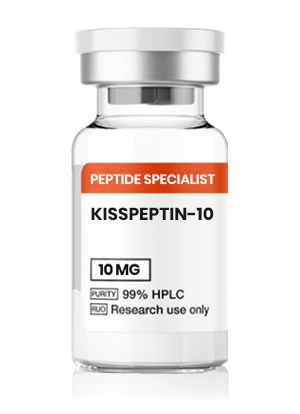
Buy Kisspeptin-10 10MG Peptide AUS
 Kisspeptin-10 Peptide (10mg Vial)
Research Purity: ≥99% | For Laboratory Use Only
 Product Overview
Kisspeptin-10 is a biologically active peptide fragment derived from the KiSS-1 gene and is a key regulator within the hypothalamic–pituitary–gonadal (HPG) axis.
It is extensively studied for its role in stimulating gonadotropin-releasing hormone (GnRH) secretion, making it central to reproductive endocrinology and neurohormonal signaling research.
Kisspeptin-10 is commonly used in laboratory models investigating hormonal regulation, fertility signaling, puberty onset, and hypothalamic function.
 Key Benefits (Research-Based)
 GnRH Stimulation — Studied for triggering pulsatile GnRH release from the hypothalamus.
 LH & FSH Regulation — Investigated for downstream effects on luteinizing hormone and follicle-stimulating hormone secretion.
 HPG Axis Modulation — Central to research on reproductive hormone signaling and feedback loops.
 Puberty & Fertility Research — Widely studied in models of pubertal onset, fertility signaling, and reproductive health.
 Neuroendocrine Signaling — Explored for its role in hypothalamic sensitivity and hormonal coordination.
 Common Research Stacks (Synergistic Pairings)
Kisspeptin-10 is frequently studied alongside peptides and compounds that complement neuroendocrine, hormonal, and metabolic signaling pathways:
Kisspeptin-10 + GnRH Analogues
— Investigated for layered analysis of hypothalamic signaling and pituitary hormone response dynamics.
Kisspeptin-10 + CJC-1295 (No DAC)
— Studied for combined effects on hypothalamic–pituitary signaling and endocrine axis coordination.
Kisspeptin-10 + Ipamorelin
— Explored in research models examining interactions between reproductive and growth hormone signaling pathways.
Kisspeptin-10 + Epithalon
— Investigated for neuroendocrine aging research, circadian rhythm interaction, and hormonal regulation.
Kisspeptin-10 + MOTS-c
— Studied for cross-talk between reproductive signaling, metabolic status, and mitochondrial communication.
 All stacking references are intended strictly for controlled laboratory research to evaluate complementary biochemical and neuroendocrine pathways.
Be the first to review “Buy Kisspeptin-10 10MG Peptide AUS”
Related products

Peptide AUS
Peptide AUS

Peptide AUS

Peptide AUS

Peptide AUS

Peptide AUS

Combos AUS

Peptide AUS
Reviews
There are no reviews yet.